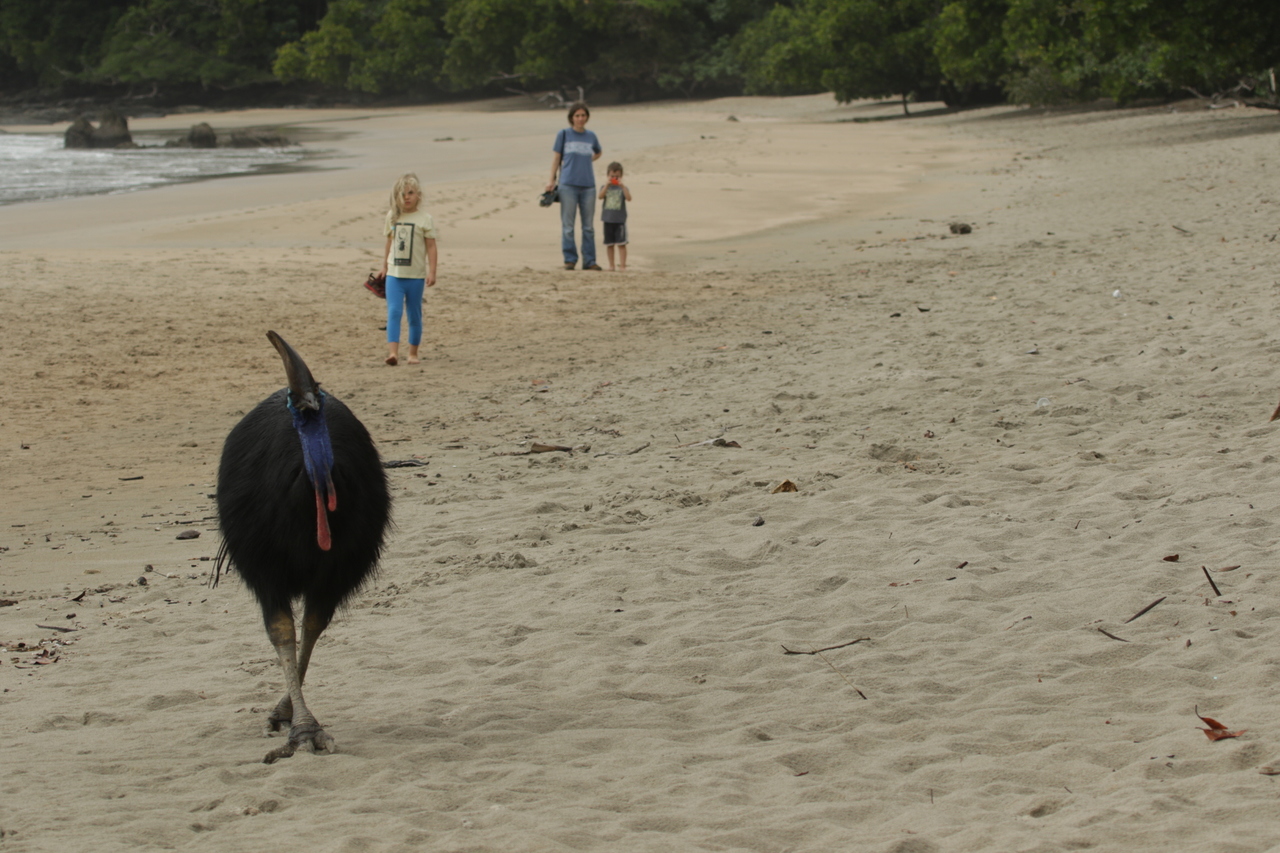
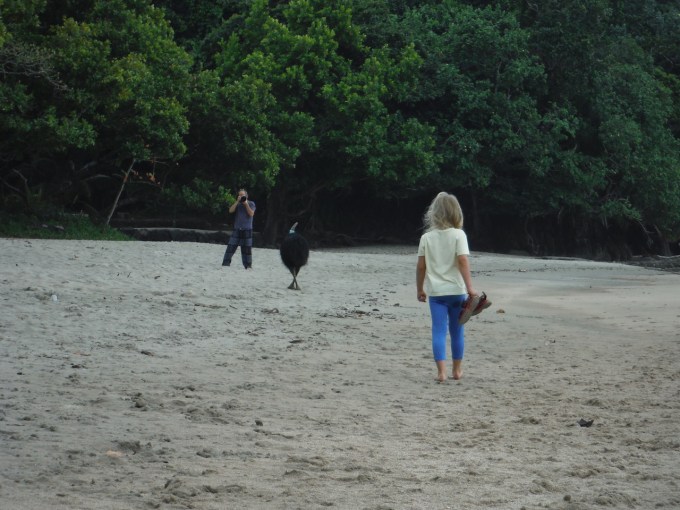
Our plans to have our muesly breakfast on the short were interrupted by Etty, the local cassowary matriarch, which came by to patrol her territory. While I ran to fetch the camera Lilach kept the kids at a safe distance. This, however, left the fruit exposed on the table. So when I returned I found one of the locals guarding the table to ensure the big bird doesn’t get to the fruit – not for our food’s sake but in order for her not to develop bad habits. Truth be told, Etty seemed very civilized, and made no attempt to steal food from the table. But after admiring her and taking some pictures we still preferred to take our breakfast on the balcony of the kiosk rather than on the beach, in order not to tempt her.
After breakfast, we spent some time parked on the shore, reading aboriginal stories with full view of the sea through the large back window. Forgetting about Tamar’s sandals and my thongs (the local term for flip-flops) which were drying up on the shore, we drove to the MA:MU Tropical Skywalk. It’s a trail of ~3km, part of which is an elevated boardwalk at the height of the canopy. It’s located right next to the the Palmerston Highway that cuts through the rainforest, connecting Millaa Millaa to the shore near Innisfail, on lands of the Mamu tribe. We got there under incessant rain and decided to have out lunch first and wait for the weather to improve. By the time we finished our lunch the rain didn’t completely stop, but got lighter, and we decided to start the trail regardless. A nice lady greeted us at the entrance with umbrellas, and asked us where we’re headed next. We told her we would probably return to Etty Bay to look for our footwear, and she immediately called her colleagues at the ticket booth on the radio, and asked them to phone the kiosk at Etty Bay and see if they could find our stuff and stow it away for us until we get there.
At the ticket booth they already expected us, and indeed connected us to Etty Bay where they located the sandals and said they would keep them till we pick them up. We accepted the offer to combine the ticket with discounted entry to Paronella Park, which we intended to visit next anyway, including free camping there. Our first finding was right next to the ticket booth – a long and very slender thing about 12cm long and only a couple of millimeters wide, glossy black and with a silvery-blue line going across its back. Under close examination we noticed a couple of minute antennae at the front. Based on that and the way it moved, leaving a thin stripe of slime behind it, we concluded that it must be some super-strange slug – a conclusion confirmed by one of the staff. I showed Daniel the macro mode of his camera, which filled him with joy and caused us to spend about 20 minutes with the tiny creature, until Daniel was satisfied that he got some decent shot. In the meantime the rain subsided further.
Along the route there were numbered signs referred to in a flora guide we got, which gave lots of details about the trees and shrubs, including their various uses by and significance to the indigenous Mamu. We also had an audio guide that provided some information at key points along the trail. One of the texts gave a short history of Christie Palmerston, the explorer who discovered the path through the rainforest that became the Palmerston highway. They said that despite widespread stories of his birth to a nobleman (the Viscount Palmerston, Prime Minister of the UK at the time, being a favorite alleged father) and a famous Italian opera singer, he was actually born on a dairy farm. The Wikipedia entry, by the way, contains a version of the noble upbringing story. The turbulent life of this explorer included living with the local Mamu tribes and speaking their languages as well as solo raids on them as revenge for attacks on white prospectors and travelers; cutting several important tracks through the rainforest; multiple crimes against the crown, which were eventually pardoned in view of his other activities; and eventually an untimely death in Borneo, where he went prospecting and caught fever in the jungle.


While I was listening to the story of Palmerston, the rain resumed and we took shelter on the partially roofed high cantilever that hangs 20 meters above the forest floor. The kids used their closed umbrellas as light-sabers, Daniel training his young padawan Tamar in the Jedi arts (being the family expert on the subject), while their parents admired the surrounding forest in the rain. The track ended in a high observation tower, which offered beautiful views of the cloud-shrouded mountains and the Johnston river winding through them, as well as an elevated view of the active bird-life in the canopy. We were so engrossed that we lost track of time, until I suddenly discovered it was 5:10pm – 20 minutes to closing time. We dashed back through the 2km to the ticket booth, where the friendly cashier gave the kids tattoo stickers for their effort – one of each animal tattoo she had on stock…


We arrived at Paronella Park before dusk and after a light dinner at the caravan joined the 8pm night tour. The place was built by one, José Paronella, a Spaniard who arrived in Australia, had a dream of building a castle, and decided to realize his dream on a parcel of land near the Mena Creek Falls. He built his castle, complete with ballrooms, tennis courts, tea gardens and a movie theater, and lit it with electricity from a small hydroelectric plant he built at the falls. He also planted over 7000(!) trees in and around the park. The place opened to the public in 1935, and was the only place with electricity in that area of the country. After Paronella’s death the park was managed y his descendants, until it was sold in 1977. A fire and a series of cyclones reduced it to ruins, and the property stood for sale for many years, until in 1993 another dreamer who moved to Queensland from Western Australia saw the sale sign, bought the place for $400,000 and decided to restore it to its glory, including re-installing the hydro-electric power plant, which now provides electricity back to the grid. Nowadays the place is a very friendly ruin, where you can easily imagine ghosts walking the gardens at night, and the many trees planted in the 1930’s turned into a lush secondary rainforest. The young guide who escorted our group through the gardens, staircases and tunnels must have felt that our family was not quite in its element, for at the end of the tour she whispered “come with me, I’ll show you something special”. In a space next to the old dressing rooms, she showed us a small colony of microbats, which were hanging from the low ceiling at eye level and could be seen in detail. A very good finishing note for the long day.


 Family Trips