After breakfast, Tamar found a large tree frog in the ladies rooms. In fact, it was not merely large, but a Giant Treefrog (Litoria infrafrenata). I was called to catch it, since it was located at the top of a dividing wall, out of Tamar’s reach (how she came to see it there is a question she refused to answer). We all took photos of the frog, and the kids were extremely amused when it jumped from Tamar’s knee straight to my face, spreading her legs from forehead to chin. The photography team was not quick enough (fortunately for me), and only caught it when it was already comfortably situated on top of my head. However, when the same trick was repeated on Tamar’s face, Daniel managed to get a good shot!


After photographing the frog ad nauseam and paying our due respect to the wallabies for the last time, we headed to the Atherton Tableland. This small volcanic plateau has several crater lakes, surrounded by pockets of high-altitude tropical rainforest, and we vividly remembered it from our 2007 visit as a wildlife watching hotspot. Our first destination there this time, however, was one we never visited before. In 2007 we were told that the best place in the tablelands to look for a platypus was Peterson’s Creek in Yungaburra, where we indeed managed to see the platypus after dark, dimly lit by flashlights. This time, however, we read that there was a place where platypi can be seen active in broad daylight! We therefore headed straight to Lake Tarzali. We got there around 3 in the afternoon, and discovered that the place was primarily an “aquaculture park” – a euphemism for fish ponds where you can fish for barramundi. They also have a smokehouse where they smoke fish and other meats, and a small kiosk. Presumably they discovered a healthy population of platypi in one of the natural ponds in the park, and realized it could be a greater attraction than the others. Anyway, we were greeted at the kiosk by a lady who seemed like a hybrid of Pippi Longstocking and Principal Trunchbull from Roald Dahl’s “Matilda” – 100kg of frighteningly smiling beauty with two long pigtails. She told us we could choose between platypus viewing alone ($5 pp), viewing + coffee/beer ($8) and another options (perhaps also with a cake) for slightly more. They also had the option of parking there for the night, in which case the platypus viewing is complimentary. We said that we considered staying there for the night, but preferred to watch the platypi first, and decide later if we want to add something to that. She charged us the base tariff, and said we would have to wait for “the next explanation about the platypus”, which we must hear before heading to the pools, and would start in about ten minutes. After ten minutes she gave us a short lecture about the platypus, and sent us on our way to follow the orange flags to the pool where we can see them.
Surprisingly, they were indeed there! After a couple of minutes in which we watched a happy family of turtles and a lonely gosling, a small platypus emerged, spent some time on the surface, then dove back down. We watched the pool for about an hour, and saw several individuals coming up shortly to breathe, and occasionally spend more time swimming at the surface, apparently feeding among the water plants. Rain drove us to leave the spectacle, but we decided we must stay for the night and continue the next morning. When we returned to the kiiosk we were surprised to find everything closed and shut. We called out, and Trunchbull appeared behind the hut with another man. We told them we would love to camp there that night, but they said they couldn’t let us since “the tills are already closed”. She also claimed that she had “clearly told us” they close at 4:30pm (needless to say, none of us heard any such warning). We left the place somewhat frustrated, and headed to Yungaburra, where we decided to spend the night in front of “On the Wallaby” – a backpacking hostel that we had fond memory of. For a small fee they let us park there and user their kitchen and shared spaces. We grilled some skewered meats, opened a bottle of Marlborough Sauvignon Blanc, and our mood improved.
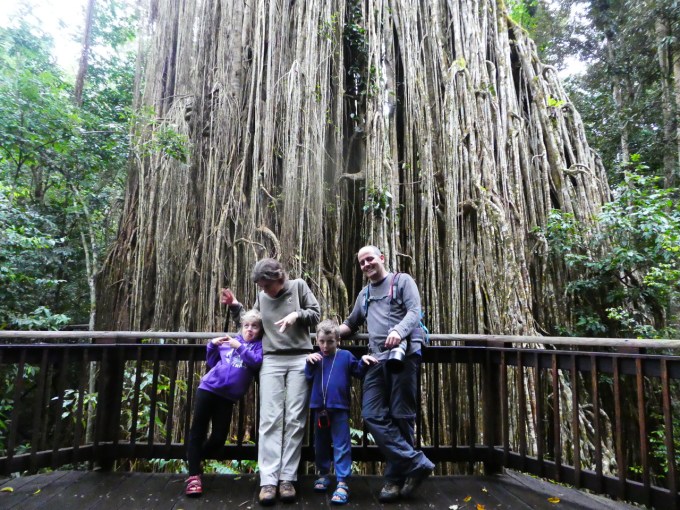
After dinner we paid a night visit to the Curtain Fig Tree located about 5km out of town. This is a strangling fig whose host tree collapsed many many years ago onto a nearby tree, causing it to expand and create a huge “curtain” of merged air-roots. The huge tree is a whole ecosystem in itself, and supports rich fauna and flora, entitling it to a tiny national park of its own (aptly named “Curtain Fig National Park”). We followed the boardwalk approaching and circling the tree with headlights and flashlights, and saw several nocturnal mammals high up which we couldn’t identify. On the way back to the caravan, Lilach found a Green Ringtail Possum at eye level, close to the boardwalk, and we had a good opportunity to closely examine this beautiful possum. The green color of its fur is said to result from a combination of grey, yellow and black hairs. On the way back to our camping spot we saw a Long-nosed Bandicoot crossing the road, and a rabbit disappearing into the roadside grass.
 Family Trips