We took a road which seemed rather forsaken from Eungella south to the Queensland Gemfields. This area has towns with telling names like Emerald, Rubyvale and Sapphire, and is an attraction for people who wish to do some fossicking – the official term for non-commercial precious stone hunting. This kids seemed really excited by the idea of looking for real gems in the ground, and we decided that it may be a welcome change for them from our wildlife-focused routine.
We arrived at Sapphire late on the 19th, and found a place in the Blue Gem Caravan Park, which proclaims to be “The Friendly Caravan Park” and was indeed so. The next morning, we headed to their “fossicking park” (an area next to the kitchen with some fossicking equipment), purchased a bucket of “wash” (i.e. dirt with some stones, some of which hopefully valuable, obtained from a nearby mine), and were instructed on the use of the sieves and the willoughby in order to filter the stones of appropriate size and concentrate the heavier ones in the center of the sieve for close examination. Indeed, our bucket yielded quite a few tiny pieces of what looked like greenish to bluish glass, and were in fact sapphires.
Encouraged by our early success, we decide to try the real thing next. So we hired a full set of equip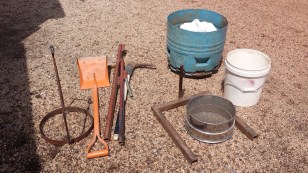 ment – sieves of two diameters, willoughby and water drum, shovel, pick, and even a hessian bag on which to turn our stones for examination. And of course – four plastic pincers for holding the jewels to the sky and skillfully examining their coloration and clarity, like every expert fossicker must do. With some effort we loaded that lot to our motorhome (the water drum didn’t fit in the storage area and we had to share the living area with it), and headed out to a carefully chosen fossicking area to try out our new skills for real, and spend the night in the real bush.
The government of Queensland designated several areas exclusively for fossicking, forbidding any commercial mining activities in them so as to leave some stones for the amateurs. We browsed the list of such areas, with detailed description of each of them (courtesy of the Blue Gem) and found one which sapphire occurrence is relatively shallow, hasn’t been “extensively worked”, yet wasn’t too far from sapphire the town. This site – Glenalva – was about 30km away. We carefully followed the instructions to stay on the ridge, since the gullies may be muddy and hard to get out of after a couple of days with some rains, and parked in an area which was supposed to be potentially rich in sapphires, based on the description in the booklet. We found some existing unoccupied digging holes and started expanding one of them, as that was supposed to be one of the recommended ways to get a good wash. It didn’t take us long to fill a bucket with… well, with something. It didn’t at all look like the wash we practiced with at the caravan park. First, it had the consistency of clay. Second, it had stone concentration which also resembled pottery clay. In other words – it was clay. Undeterred, we set to work on our newly obtained raw material, filtered, washed and concentrated it, then threw it all away. It didn’t seem to contain any heavy stones at all – no ironstone or spinel, not to mention sapphire. In order to keep the children happy, I added to the mix some gravel from the pre-filtered piles that previous fossickers must have left behind. This at least enabled us to go through the motions for a while before deciding it was time to look for some wildlife under the pretense of seeking better digging sites. Indeed, Lilach found a couple of Eastern Grey Kangaroos, and we both found some interesting birds – Rufous Whistlers, Green Orioles, Little Friarbirds, and many Apostlebirds and Babblers. Lilach also saw some Red-backed Fairy-Wrens. More than anything else, however, the place was full of lovely butterflies of various sizes and patterns. All in all, we decided that fossicking was in fact a good way to see a part of the bush that we would have otherwise probably not seen.
We prepared dinner and went to sleep – not richer, perhaps, but pretty satisfied. During the night, heavy rain started to fall, and we imagined that our mobile home started tilting gently to the left. Getting out of our carefully chosen parking place began to seem a less trivial task than originally perceived. But there was not much to do, so we kept dry and warm inside, and let the rain fall. We woke up to a beautiful day, with clear blue skies above and mud and puddles below. Around breakfast time, a nice young guy in a 4×4 truck arrived and parked next to us. I asked for his advice on finding some sapphires, and he explained that after such rains there was no use trying to filter wash – “it’s too heavy anyway”. What we should do is “speck” – walk around and look for sapphires that were uncovered and washed by the rain. Where? “Anywhere, in the fields”. To help us know what to look for, he took out four gems he found the other day – each much larger than our whole treasure of the previous day combined – and threw them on the ground. “That’s what it looks like. Much like glass, really”. We therefore spent the next few hours specking the fields, and indeed found quite a few more birds, several pieces of quartz which Tamar and Daniel wanted to keep, and lots of glass fragments from broken bottles. Determined to become rich from our experience in the gemfields, I filmed a short tutorial featuring Daniel, who explained all the intricate details of fossicking techniques. I’m sure more money can be made on youtube from this tutorial than on the field from fossicking…
By then it was already early afternoon, and the road seemed dry enough to drive with no difficulty. We therefore decided to quit our fossicking career at its apex, and head to Carnarvon Gorge – our next stop. After returning the equipment to the friendly staff at the Blue Gem, we headed south again, and stopped for the night at some lookout point which the Camper Mate application indicated as a free camping spot. We were shortly joined there by a young trio of travelers – a French couple from Lyon and an American guy from Cleveland, Ohio. Sitting at the same large picnic table for dinner, we shared our wine with them and they shared their stories with us.
 Family Trips