On our second morning in Granite Gorge we paid another visit to the wallabies, photographed some birds, said goodbye to the Lace Monitor and the Gallah kept on the balcony of the reception building, and headed west to Chillagoe.


Chillagoe is a largely deserted mining town on the edge of the outback, about 140km west of Mareeba. At its heyday it was a town of more than 10,000 people – mostly gold and copper miners, whereas now it is home to less than 250 people. We wanted to see what that is like – both in terms of the fauna and flora in the more arid regions, and in terms of the human landscape. We also wanted to explore the adjacent Chillagoe-Mungana Caves National Park, and to look at the southern skies from a place far away from light pollution – something for which Chillagoe is also famous. We therefore booked a site at the local “Observatory and Eco Park”, which operates a small observatory with a decent telescope on premises, where they have guided star watching sessions when the skies are clear.
On the way there, Lilach noticed some large bird shapes in an adjacent field, which turned out to be a group of Emus! We made a U-turn, headed into a dirt path along that field and had a wonderful opportunity to look at these impressive birds strolling and picking up grass and grains in the field. Daniel took some pictures perched on my shoulders, while I had to settle for a lower vantage point.


Shortly after the Emu encounter we met another group of birds we had long wanted to see – Australian Bastards. It looked like a pair with five nearly grown-up chicks. Bastards are usually perceived as really large birds, but not in comparison with the Emus… When we got further west, the tarmac was replaced by unsealed gravel road for long stretches at a time, and signed warned the drivers of “Road Trains” – trucks with double trailers that roam these roads, creating huge clouds of dust. When we reached the sleepy town and the campsite we had a chance to see some more bird activity before sunset, then went to the observatory for a guided tour of the night sky.


Through the telescope we watched the Omega Centaury globular cluster, containing millions of star systems, the colorful Jewel Box star cluster, the face of Mars, and Saturn and its rings. In between, we had a good look at the Milky Way, and got introduced to some familiar constellations, and some others like the Emu in the Sky (actually not a star constellation but rather a shape made by dust clouds hiding the stars) which play a role in Aboriginal astronomy. According to our guide, when the Emu engraving found in Ku-ring-gai Chase National Park matches the Emu in the Sky in size and orientation, its the beginning of the Emu breeding season – an important event for the aboriginals since Emu eggs were a significant food source. Tamar discovered a “half heart” constellation, and our guide (somewhat disappointed at being scooped) confirmed this to be the Southern Crown – Corona Australis. The guide told us about the divisions between the many rings of Saturn – bands in which there are very few objects, in contrast with the densely populated rings, the biggest of which is the Cassini Division between the two main ring groups which can be easily seen from earth. However, she had no idea what causes these gaps and said she eould really love to find out. I was left with the mystery for another couple of hours, until a google search revealed that some of them are actually “cleared” by micro-satellites, while others (Cassini’s included) apparently form due to the gravitational pull of the larger satellites at “resonance points” – very interesting in fact. We ate dinner by a small campfire, and everyone went to sleep very satisfied.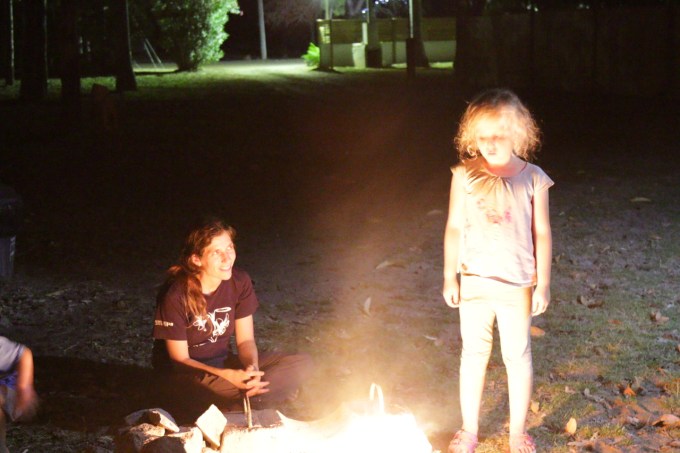


so lovely to hear, and watch and almost participate with you in realtime. sending hugs to you all (tuvik – holding you responsible to dispense these hugs. will pay back when we meet).
LikeLike
Immediately fulfilled my obligation. Hugs back – waiting to talk to you and see you after our return.
LikeLike
Looks like my response, from the day after you left your comment, was only srnt now. Oh well… 🙂
LikeLike